Your Startup Has Competitors. Here's How to Present Them.

Quick Answer

A strong competition slide doesn't say "we have no competitors." Instead, it acknowledges real alternatives—including the status quo, spreadsheets, hiring an employee, or doing nothing—and explains why customers would choose you on the criteria they actually care about. Different is not the same as defensible.

Why This Matters to Investors

"We have no competitors" rarely makes a startup look strong. It often does the opposite—it can signal that the founder doesn't fully understand their own market.

Customers are already solving this problem some way. Why will you get them to change?

That's what an investor actually wants to know. The job of the competition slide isn't to pretend alternatives don't exist—it's to acknowledge them and explain why you'll be chosen anyway.

What Counts as "Competition"

What the Investor Is Really Asking

What alternatives exist, and why will customers choose you?

Competition isn't limited to other startups. All of the following can count:

  • Direct startup competitors
  • Incumbent tools
  • The status quo—not changing anything
  • Excel or spreadsheets
  • Hiring an employee
  • Outsourcing
Different is not the same as defensible.

Here's what that difference looks like on an actual slide—a weak example, then a strong one.

Weak

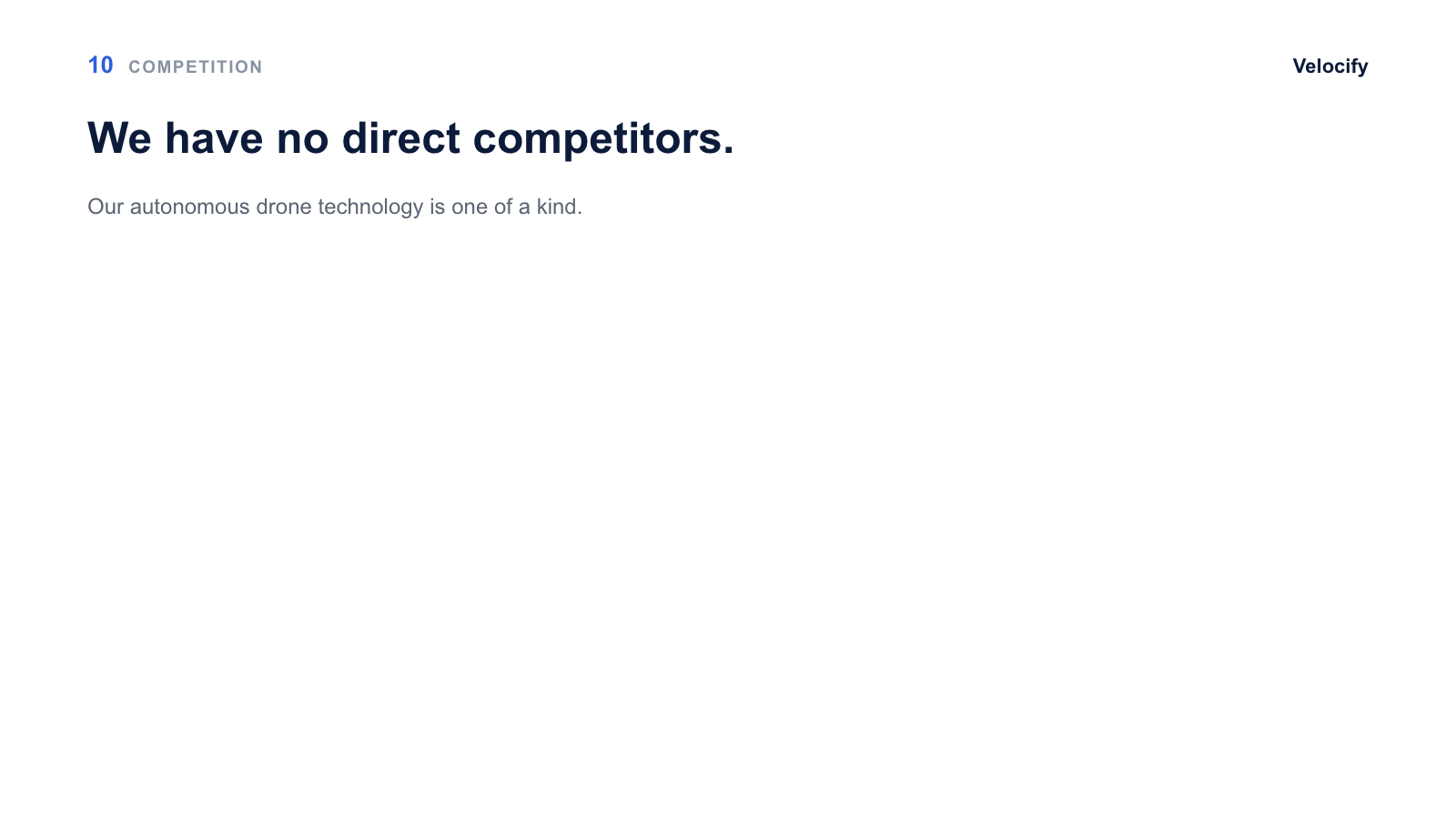
A weak competition slide that just claims 'no competitors'
  • “We have no competitors” is asserted with zero supporting evidence
  • No mention of alternatives customers already use, including the status quo
  • No explanation of why a customer would actually switch
  • An investor is left wondering whether the founder understands their own market

Stronger

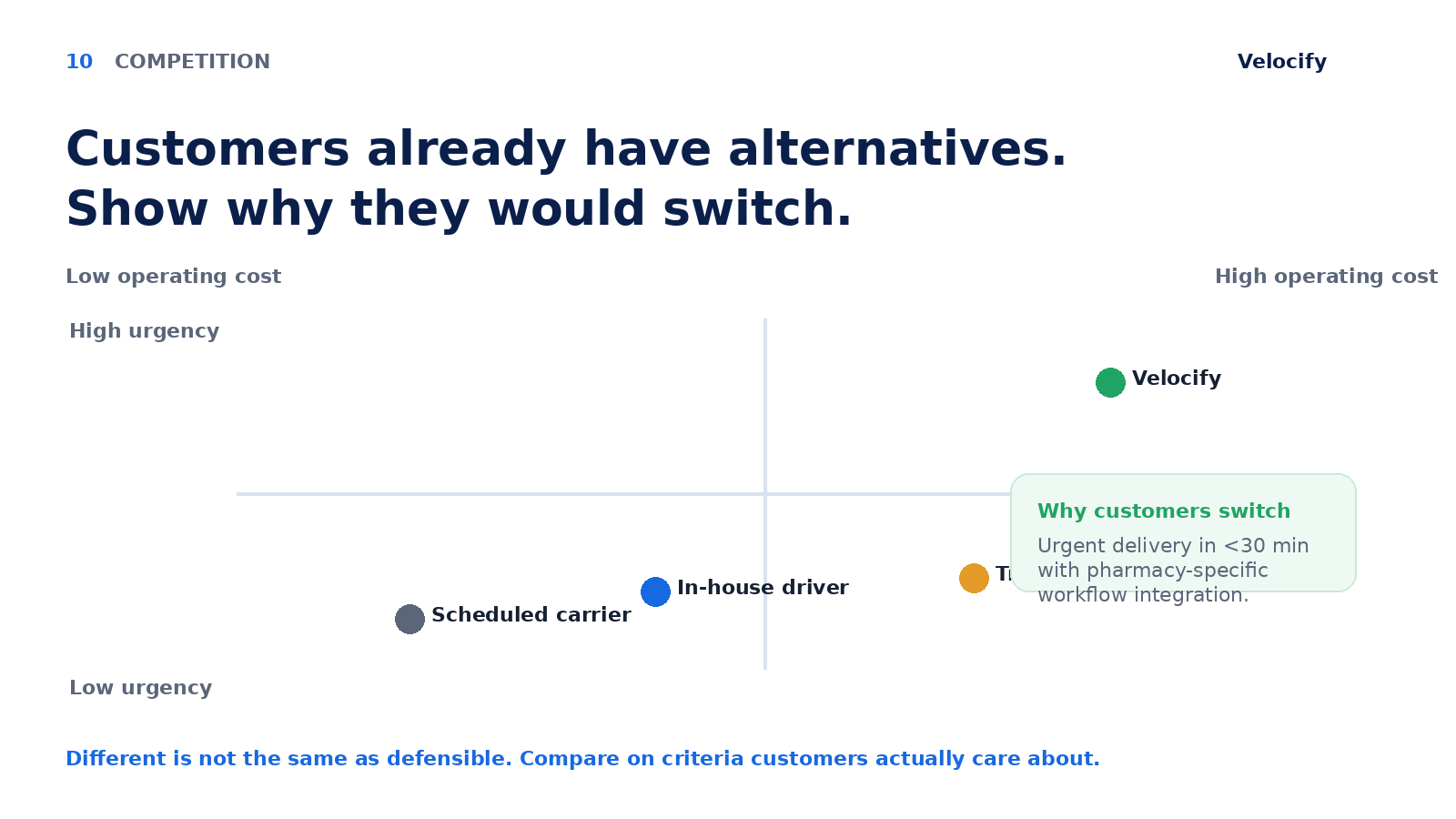
A strong competition slide that acknowledges real alternatives
  • Acknowledges real alternatives—in-house drivers, scheduled carriers
  • Positions the company on the two axes customers actually care about—urgency and operating cost
  • States in one specific line why customers would switch
  • Focuses on “why you’re chosen,” not just “how you’re different”

Common Mistakes

  1. Claiming "we have no competitors" — almost every customer is already solving this some way.
  2. Only naming direct startup competitors — the status quo, spreadsheets, and outsourcing can all count as competition too.
  3. Building a "we win on everything" matrix — if you chose every comparison criterion yourself, it means little to an investor.
  4. Confusing "different" with "defensible"— being unique doesn't create differentiation if customers don't care about it.
  5. Not explaining why customers would actually switch— listing feature differences isn't enough; show why that difference changes a customer's decision.

Checklist

  • Have you avoided saying "we have no competitors"?
  • Do you acknowledge the status quo or manual workflows as competition?
  • Are you comparing on criteria customers actually care about?
  • Have you avoided a "we win on everything" matrix?
  • Do you explain specifically why customers would switch?
  • Is your differentiation something customers actually value?
  • Is the comparison backed by evidence an investor would find credible?

How VC Radar Looks at This

  • Are real alternatives acknowledged?
  • Is the comparison framed from the customer's perspective?
  • Does it avoid a "we win on everything" matrix?
  • Is it specific about why customers would switch?
  • Is the differentiation something customers actually value?

Does your deck explain why customers will choose you—not just why you're different?

VC Radar evaluates whether your competition slide explains real differentiation, along with 20+ other criteria.

Analyze Your Pitch Deck with VC Radar →