Quick Answer
A practical pitch deck template covers 13 slides, from the cover through your fundraising ask. But filling in a template doesn't automatically make a strong deck. Below is the full 13-slide overview, plus 5 example slides pulled from a sample deck—cover, problem, traction, GTM, and competition—each annotated to show why it works.
There is no single "perfect" pitch deck format. But most investor decks need to answer the same sequence of questions.
This template follows that sequence across 13 slides. Start with the overview to see the full structure, then look at real slide examples to see why each one works.
The 13 Essential Slides
- Cover / Company Purpose — What does your company do?
- Problem — What painful problem exists, and who has it?
- Solution — What changes because your solution exists?
- Product — What have you actually built?
- Why Now? — Why is this opportunity happening now rather than five years ago—or five years from now?
- Market Opportunity — If you succeed, how large can this become?
- Business Model — How does this become a business?
- Traction & Validation — What evidence suggests reality agrees with your thesis?
- Go-to-Market — How will you actually get customers?
- Competition — What alternatives exist, and why will customers choose you?
- Team — Why is this the right team to build this company?
- Financials — If your assumptions are right, what does the economics of this business look like?
- The Ask — What are you raising, and what does that capital allow you to accomplish?
You don't need to turn every one of these into its own slide. The related guide below breaks down what each slide needs to answer in more detail.
Sample Slides From an Example Deck
Filling in the template isn't enough on its own—a strong deck needs each slide to do its job. Below are 5 sample slides from an example deck for a fictional startup, Velocify (autonomous drone delivery for suburban logistics). Each one is annotated to show why it works, from an investor's perspective.
1 Cover / Company Purpose
A cover slide has one job: make it obvious what the company does within the first few seconds. This example uses only the company name, a one-line positioning statement, and three outcome words (faster delivery, lower cost, better access). Skip the abstract tagline and give investors a clear category to file you under.
2 Problem
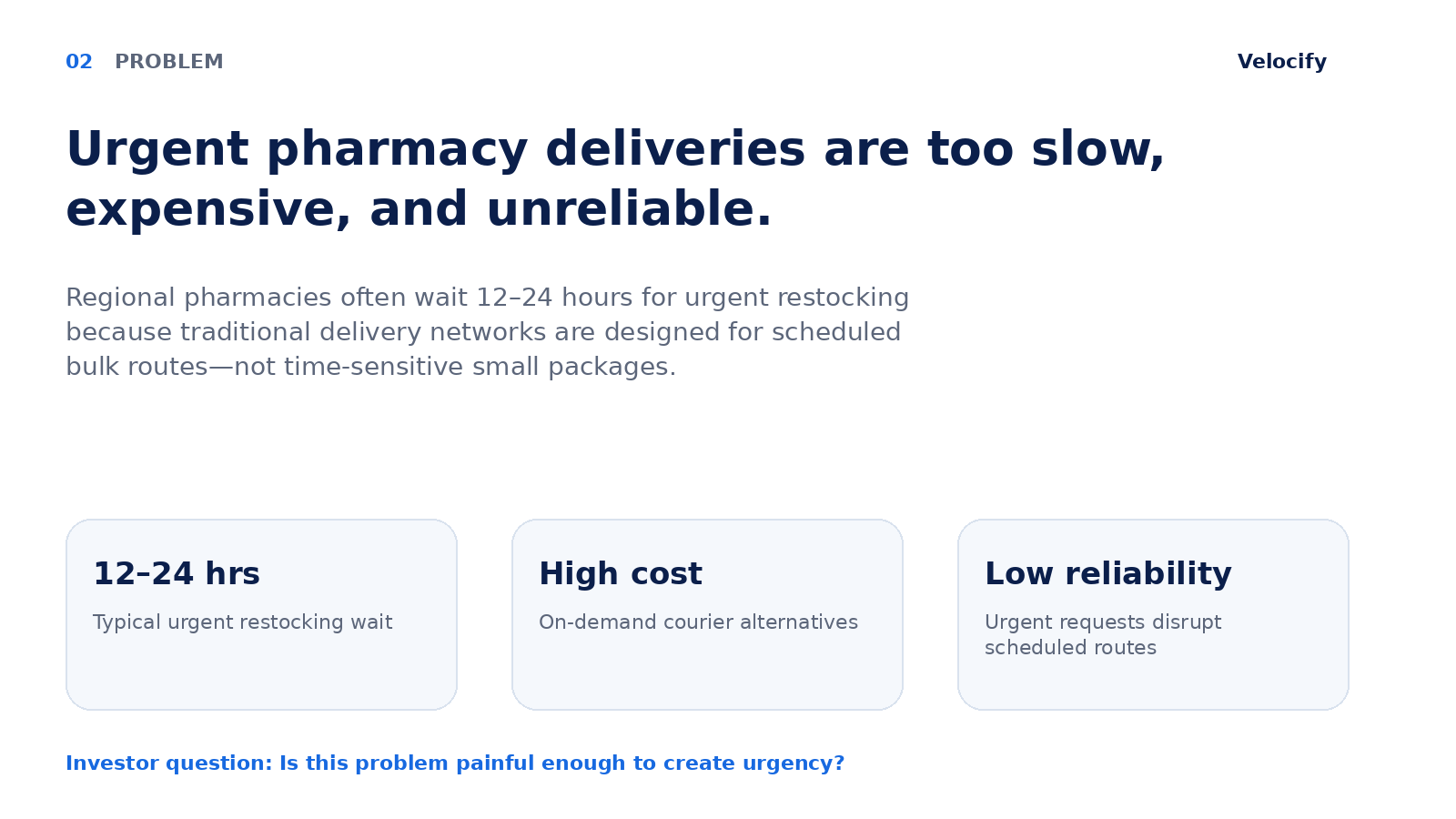
A strong problem slide makes the customer, the pain, and why existing options fall short all clear at once. This slide names a specific customer (regional pharmacies), a specific cost (12–24 hours), and backs it up with three supporting cards explaining why traditional delivery networks weren't built for urgent, time-sensitive requests.
8 Traction & Validation
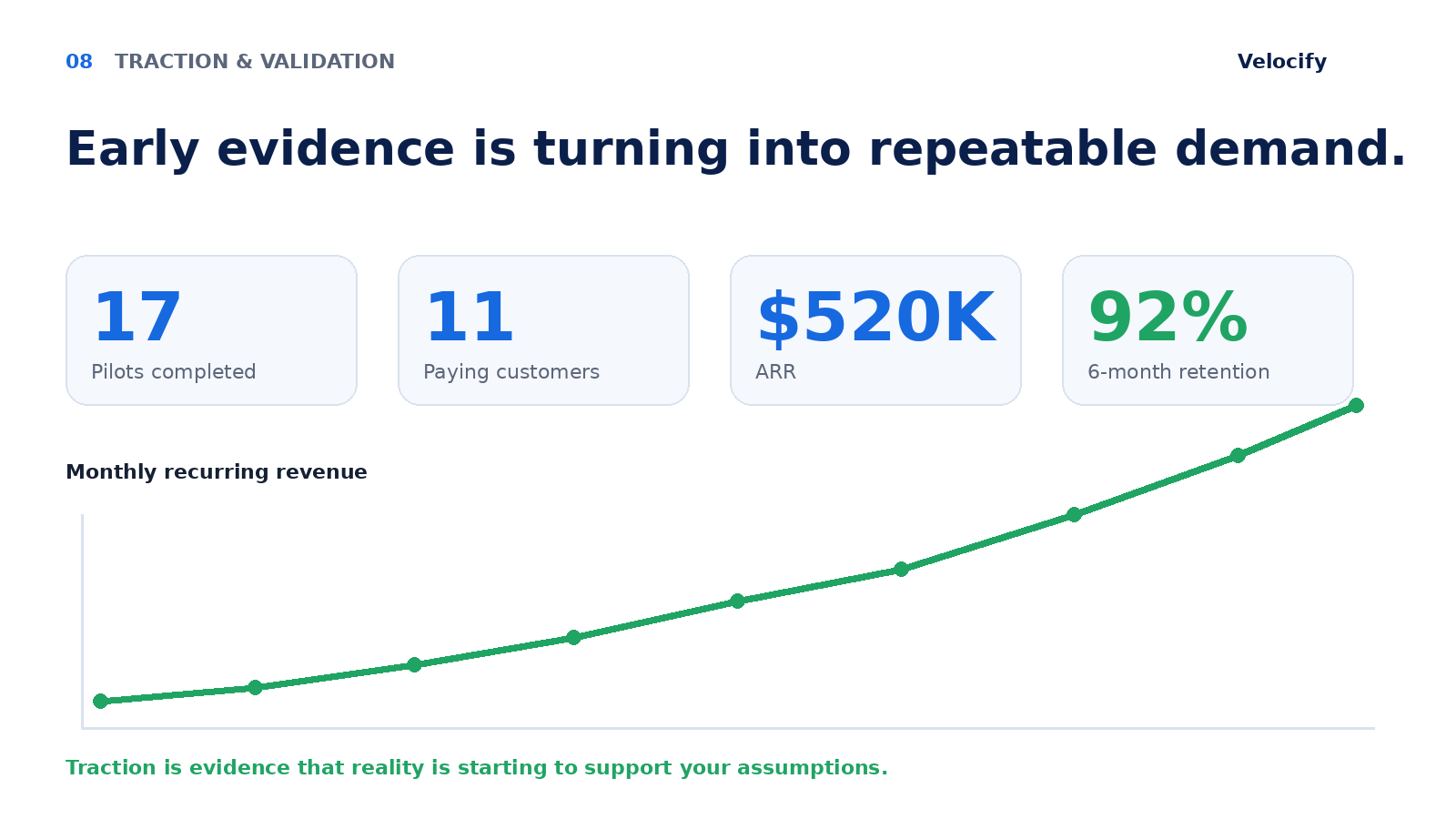
Traction slides should show evidence that reality is starting to agree with your thesis—not just activity metrics like website visitors. This slide combines four hard numbers (pilots completed, paying customers, ARR, retention) with a rising MRR chart to show that early demand is becoming repeatable.
9 Go-to-Market
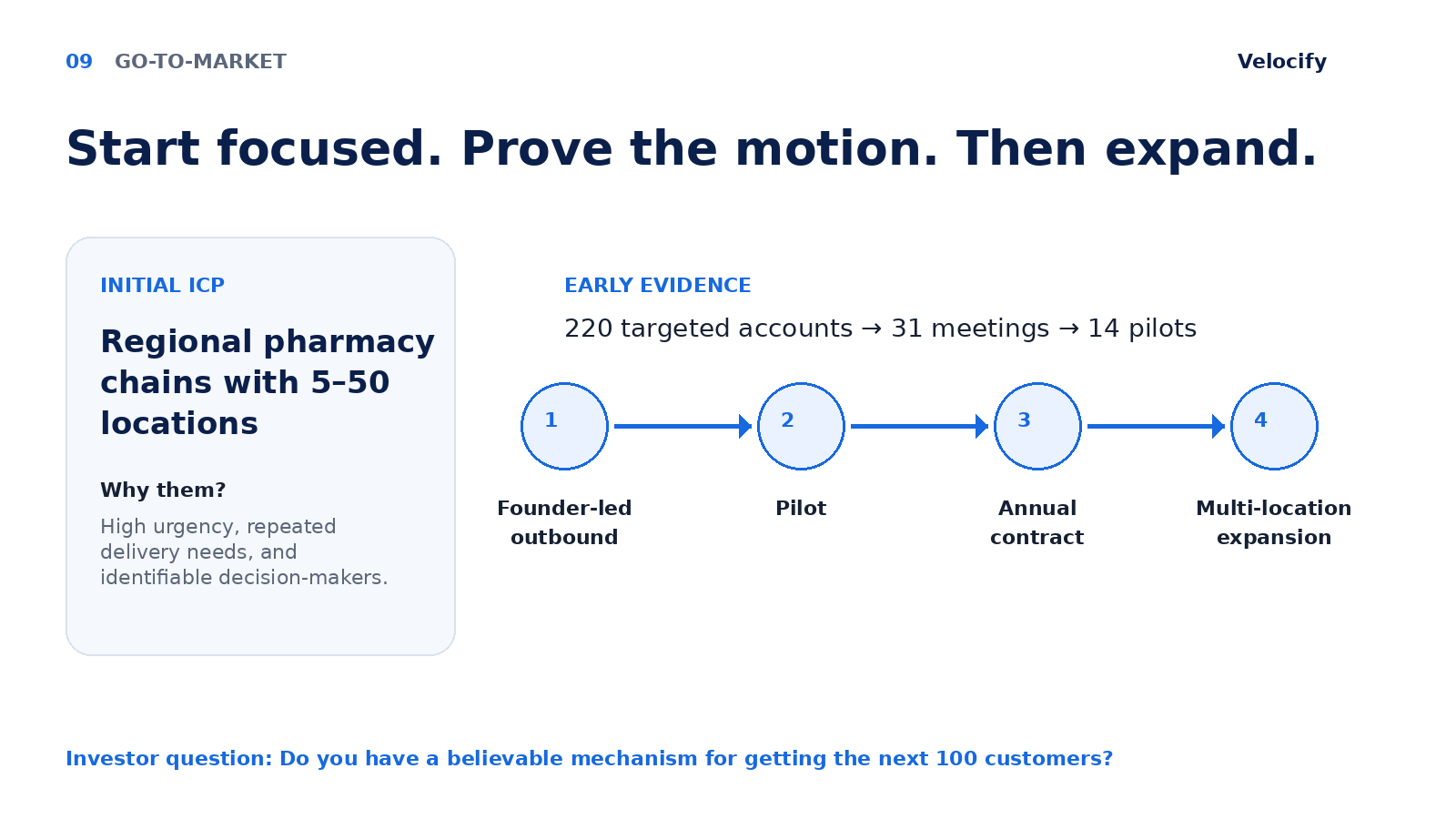
A weak GTM slide is just a list of channels. This one defines a specific initial ICP and explains why that customer, then shows the actual acquisition motion (founder-led outbound → pilot → annual contract → expansion) alongside the evidence behind it (220 targeted accounts → 31 meetings → 14 pilots).
10 Competition
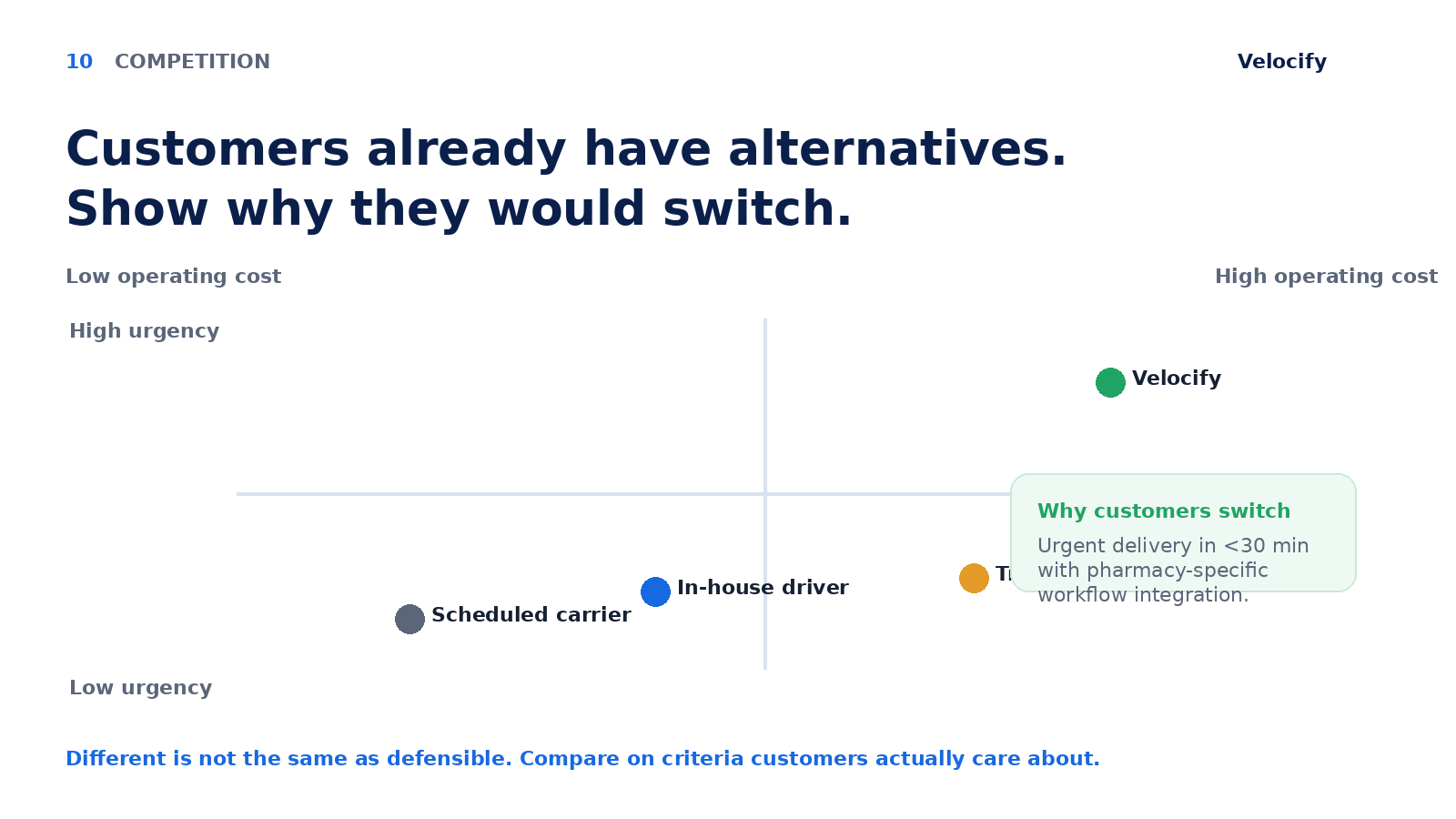
Claiming "no competitors" rarely makes a startup look stronger. This slide acknowledges real alternatives—in-house drivers, scheduled carriers—and positions the company on the two axes customers actually care about (urgency and operating cost), then states in one line why customers would switch.
How to Use This Template
- Copy the 13-slide list and fill in a title for each, specific to your company.
- Remove slides that don't apply; add slides your business needs that aren't here.
- For every slide, show evidence—numbers, specifics—not just a claim.
- Show, don't just tell, wherever possible (screenshots, diagrams, charts).
- Have someone who doesn't know your company read the deck and check whether it makes sense without you there to explain it.
For more detail on slide order and what to include on each one, see the related guides below.
Download the Template
Get the 13-slide structure above as an editable PowerPoint file. Each slide has only a title and the question it needs to answer—the content area is blank, ready for you to fill in with your own company's story.
Pitch Deck Template (PowerPoint, cover + 13 slides)
A fill-in-the-blank template with just a title and the investor question on each slide.
Download PPTXpitch-deck-template-en.pptx
You filled in the template. But does it actually land with investors?
VC Radar evaluates your deck across 20+ investor criteria.
Analyze Your Pitch Deck with VC Radar →