How to Build a GTM Slide That Shows How You Will Actually Get Customers

Quick Answer

A strong GTM slide explains who you sell to, how you reach them, how the sale happens, and what evidence supports the strategy. A list of channels—social media, SEO, partnerships—isn't a GTM strategy. It's just a list.

Why This Matters to Investors

A great product in a big market still needs customers. While reading your GTM slide, an investor is trying to answer one question:

Can this team actually get the next 100 customers?

A slide that just lists channels can't answer that. Investors don't want to know where you'll buy ads—they want to see the actual mechanism by which a customer goes from unaware to paying.

The Questions a Strong GTM Slide Needs to Answer

What the Investor Is Really Asking

How will you actually get customers?

  1. Who buys?
  2. How do you reach them?
  3. Who makes the decision?
  4. How does the sale happen?
  5. What does acquisition cost?
  6. What evidence supports the motion?
"Social Media + Partnerships + SEO" is not a GTM strategy.

That's a list of channels, not an explanation of motion. Here's what the difference looks like on an actual slide—a weak example, then a strong one.

Weak

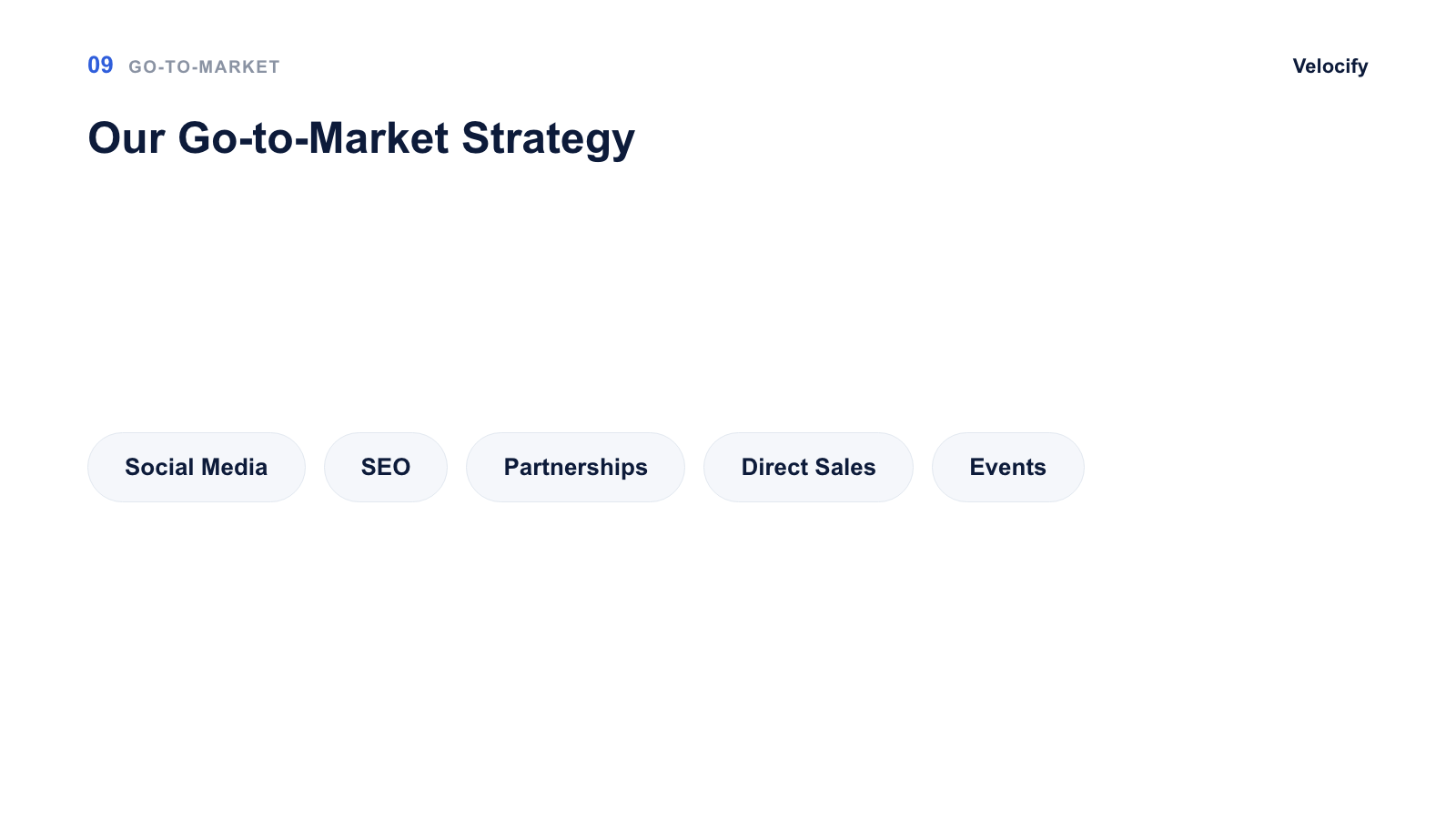
A weak GTM slide that just lists channels
  • Just a list of channels—no ICP (ideal customer profile) is defined
  • No explanation of the actual motion for reaching that customer
  • No evidence or traction shown at all
  • An investor has nothing to judge whether this will actually work

Stronger

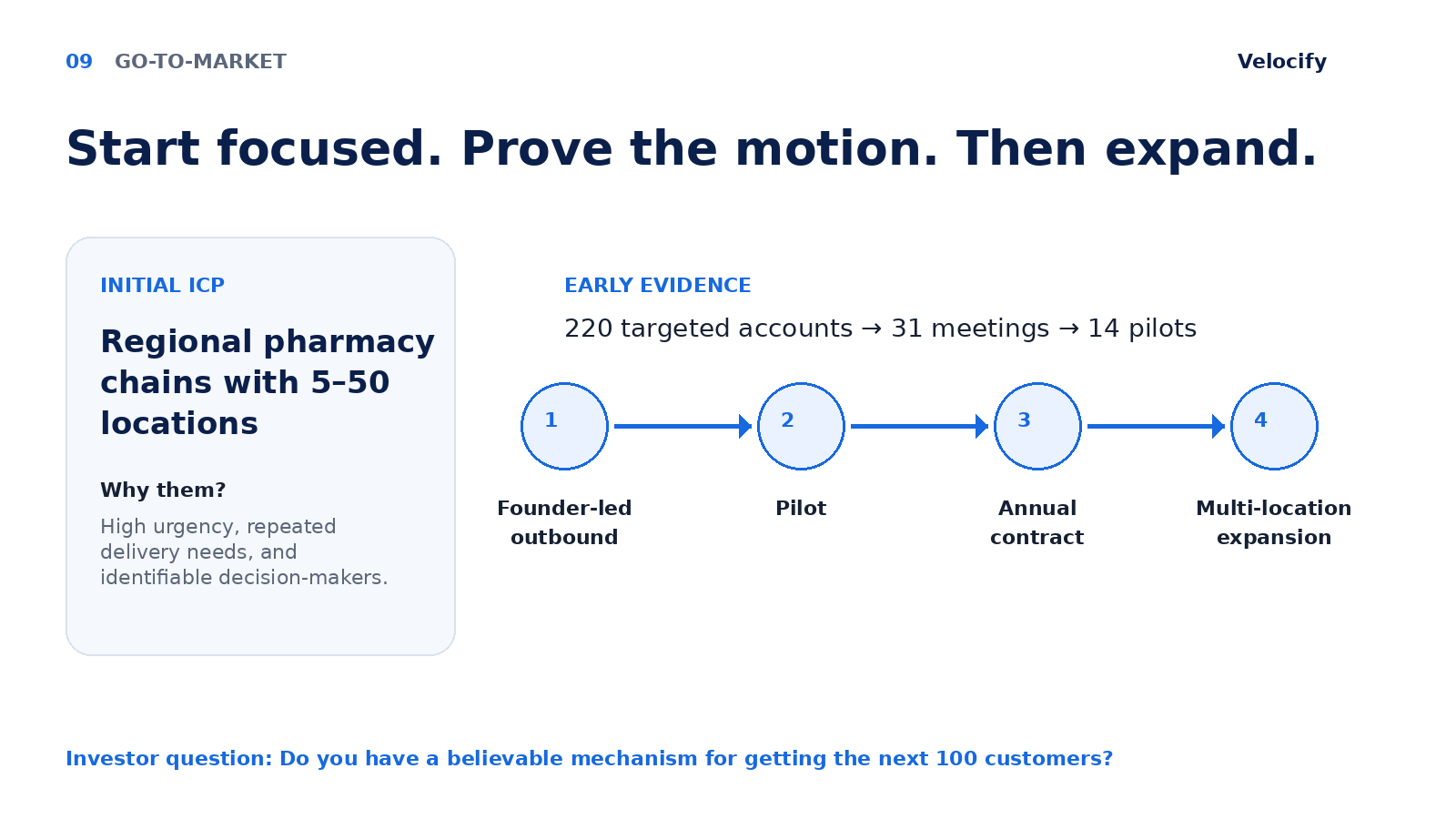
A strong GTM slide with a specific ICP and evidence
  • A specific initial ICP—“regional pharmacy chains with 5–50 locations”
  • An explanation of why that customer first
  • The actual acquisition motion—founder-led outbound → pilot → annual contract → expansion
  • The evidence behind it—220 targeted accounts → 31 meetings → 14 pilots

Common Mistakes

  1. Mistaking a list of channels for a GTM strategy— social media, SEO, and partnerships listed together don't explain the actual motion.
  2. Not defining an ICP— assuming you'll sell to "everyone" erodes investor confidence.
  3. Showing no evidence or traction — investors want to see what has actually worked, not what you expect to work.
  4. No mention of acquisition cost or sales cycle — investors want to know whether the economics actually work.
  5. Ignoring the decision-maker— if it's unclear who actually says "yes," the whole sales motion stays vague.

Checklist

  • Have you specifically defined your first ideal customer (ICP)?
  • Have you explained why you're starting with that customer?
  • Have you shown the actual motion for reaching that customer?
  • Is it clear who makes the purchasing decision?
  • Do you mention acquisition cost or the sales cycle?
  • Do you show evidence or traction that supports the strategy?
  • Does the slide avoid becoming just a list of channels?

How VC Radar Looks at This

  • Is a specific ICP defined?
  • Is the acquisition motion (channel + process) clear?
  • Is the decision-maker addressed?
  • Is the economics—like acquisition cost—addressed?
  • Is there evidence supporting the strategy?

Would an investor believe you can actually get the next 100 customers?

VC Radar evaluates whether your GTM slide shows a believable mechanism for growth, along with 20+ other criteria.

Analyze Your Pitch Deck with VC Radar →