At pre-seed, investors usually don't expect years of revenue history or a fully optimized go-to-market engine. What they want is a convincing case for six things: a real problem, a clear solution, a credible reason why now, a large enough opportunity, early evidence that reduces uncertainty, and a team worth betting on. The deck needs to show you're systematically reducing uncertainty—not just presenting an idea.
A pre-seed pitch deck is different from a later-stage fundraising deck.
At pre-seed, investors usually do not expect years of revenue history, mature unit economics, or a fully optimized go-to-market engine.
What they do expect is a convincing answer to a more fundamental question:
Why should we believe this could become a great company before the business is fully proven?
That usually comes down to six things:
A real and meaningful problem
A clear solution
A credible reason why now
A large enough opportunity
Early evidence that reduces uncertainty
A team worth betting on
Your pre-seed deck does not need to pretend you are already a Series A company.
It needs to make a strong early-stage case.
What Should Be in a Pre-Seed Pitch Deck?
A practical pre-seed pitch deck often includes:
Cover / Company Purpose
Problem
Solution
Product
Why Now
Market Opportunity
Business Model
Early Validation / Traction
Go-to-Market Hypothesis
Competition
Team
Fundraising Ask
Depending on the startup, you may also include a product roadmap, technical architecture, use of funds, regulatory strategy, or an appendix.
The important difference at pre-seed is not the number of slides. It is the kind of evidence investors expect to see.
What Are Investors Really Looking for at Pre-Seed?
At later stages, investors can evaluate years of operating data. At pre-seed, much of that evidence does not exist yet.
So investors are often evaluating:
the quality of the founder's insight,
how well the problem is understood,
whether customers appear to care,
whether the proposed solution is credible,
whether the timing makes sense,
whether the market could become large,
and whether the founders are learning quickly.
The deck should show that you are not simply presenting an idea.
You are systematically reducing uncertainty.
1. Cover / Company Purpose
What the Investor Is Really Asking
“What does this company actually do?”
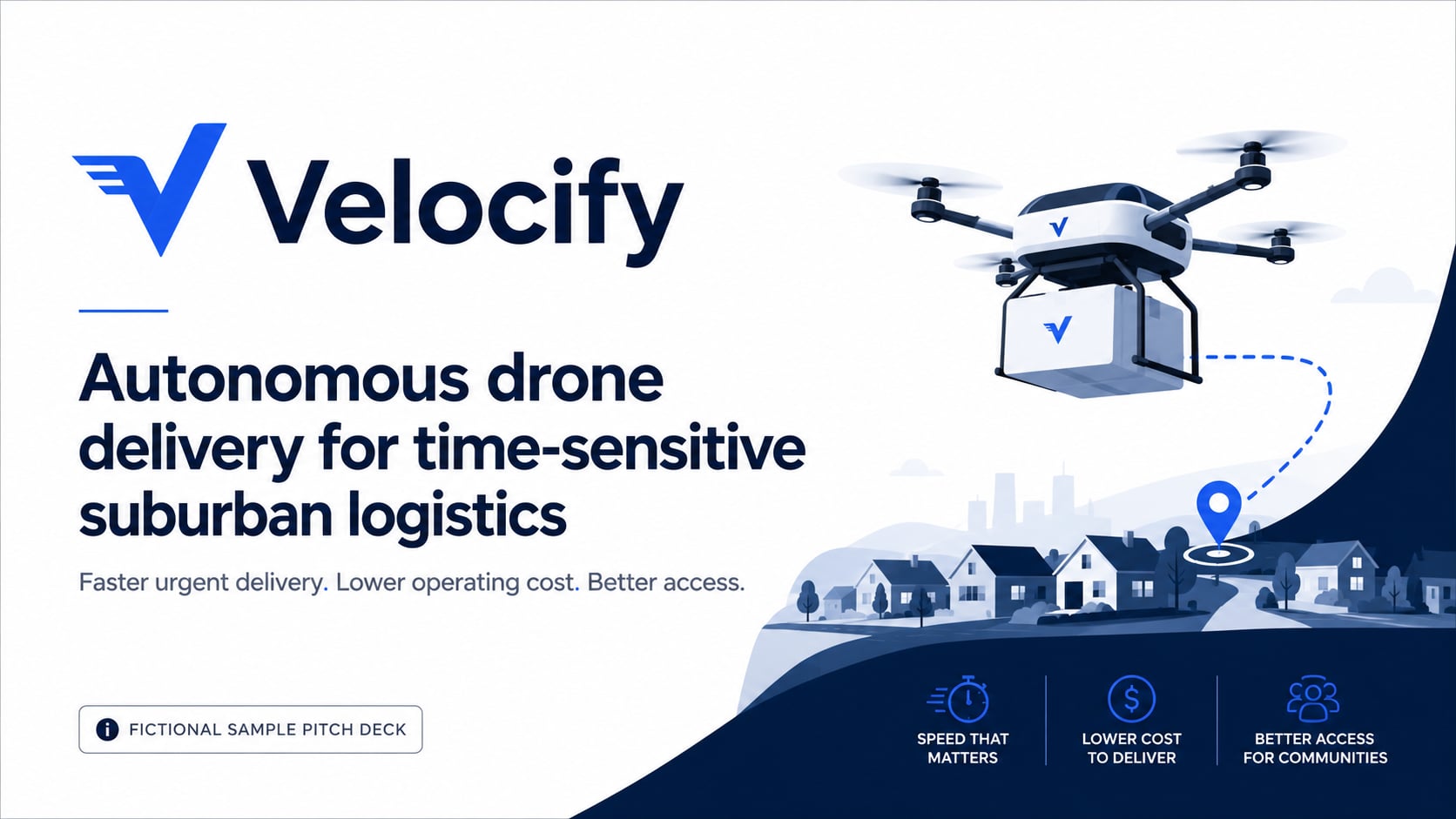
Your opening slide should make the answer obvious. Include the company name, a one-sentence description, and an optional short supporting line.
Velocify Autonomous drone delivery for time-sensitive suburban logistics.
Avoid vague slogans such as "Reinventing the Future of Mobility." That may sound polished, but the investor still doesn't know what the company does. At pre-seed, clarity is more valuable than cleverness.
✓ Stronger
✓Company name and a one-line description of what it does
✓Three concrete outcome words, not an abstract mission statement
✓Clearly labeled as a fictional sample deck
2. Problem
What the Investor Is Really Asking
“Is this problem real—and painful enough to build a company around?”
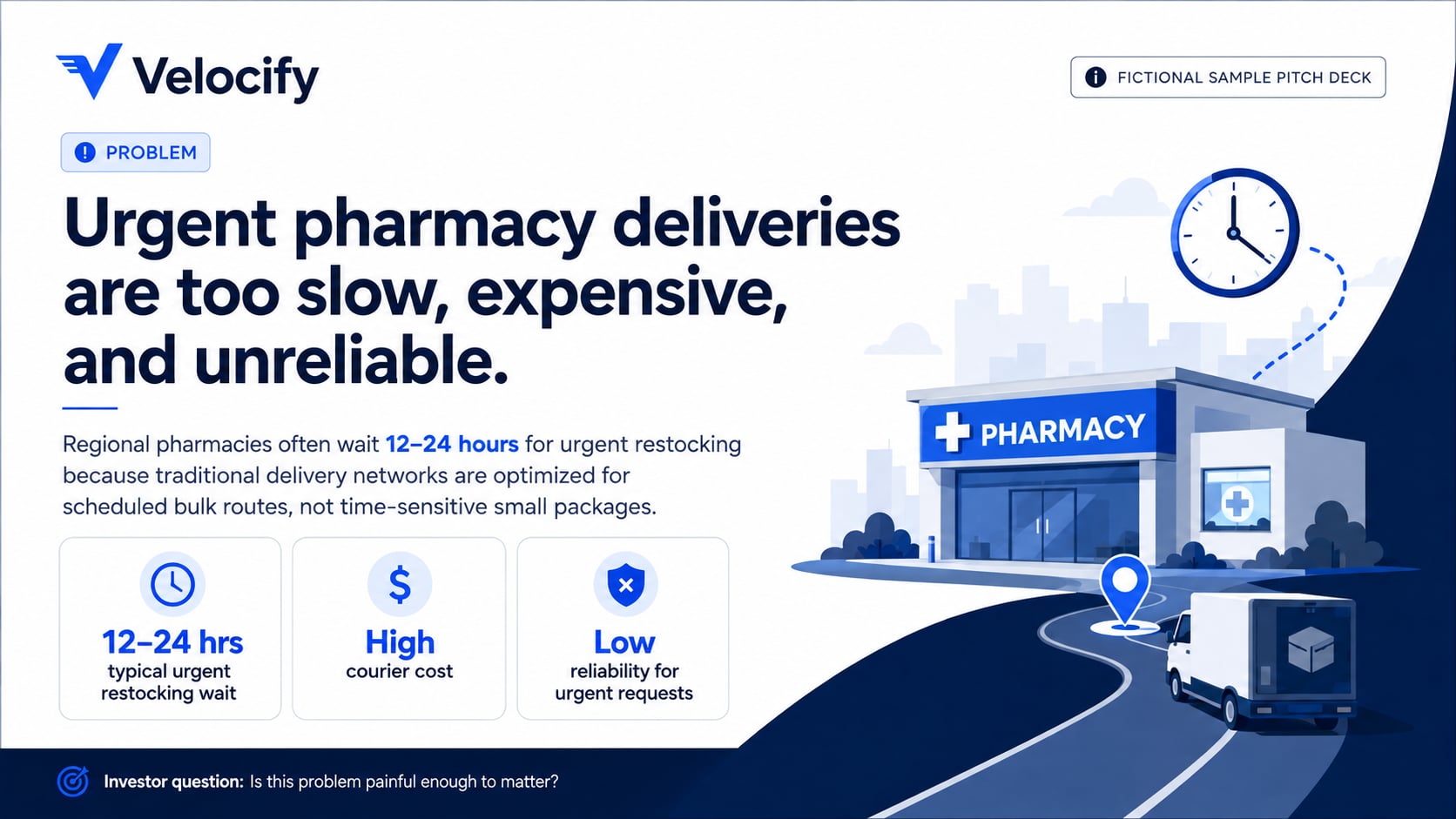
The Problem slide is especially important at pre-seed, because much of the investment thesis begins here. Include who has the problem, what specifically is painful, how customers solve it today, why existing approaches are inadequate, and evidence where available.
✕ Weak
Last-mile delivery is inefficient.
✓ Stronger
Regional pharmacies often wait 12–24 hours for urgent restocking because traditional delivery networks are optimized for scheduled bulk shipments rather than time-sensitive small packages.
The stronger version gives the investor a customer, a specific pain, and an existing limitation.
✓ Stronger
✓A specific customer—regional pharmacies
✓A quantified pain—a 12–24 hour wait
✓An explanation of why the existing delivery network falls short
3. Solution
What the Investor Is Really Asking
“What changes because your company exists?”
At pre-seed, avoid burying the investor in features or technical detail. Start with the customer outcome.
Velocify enables pharmacies to deliver urgent prescriptions across suburban areas in under 30 minutes using autonomous drones.
That is usually stronger than "AI-powered autonomous aerial logistics orchestration platform." The technology matters. But first, the investor needs to understand the value.
4. Product
What the Investor Is Really Asking
“What have you actually built so far?”
You do not necessarily need a finished commercial product. But showing something real is valuable. Depending on the stage, this could be an MVP, a prototype, a screenshot, a product photo, a demo flow, a technical prototype, or a proof-of-concept result.
If the product is still early, say so. A credible prototype is better than an overly polished slide that hides how early the product really is.
5. Why Now
What the Investor Is Really Asking
“Why is this opportunity happening now?”
A strong pre-seed story often has a clear timing component. Something changed—technology became cheaper, regulation changed, customer behavior shifted, labor became more expensive, infrastructure improved, or a new platform became available.
✕ Weak
AI is growing rapidly.
✓ Stronger
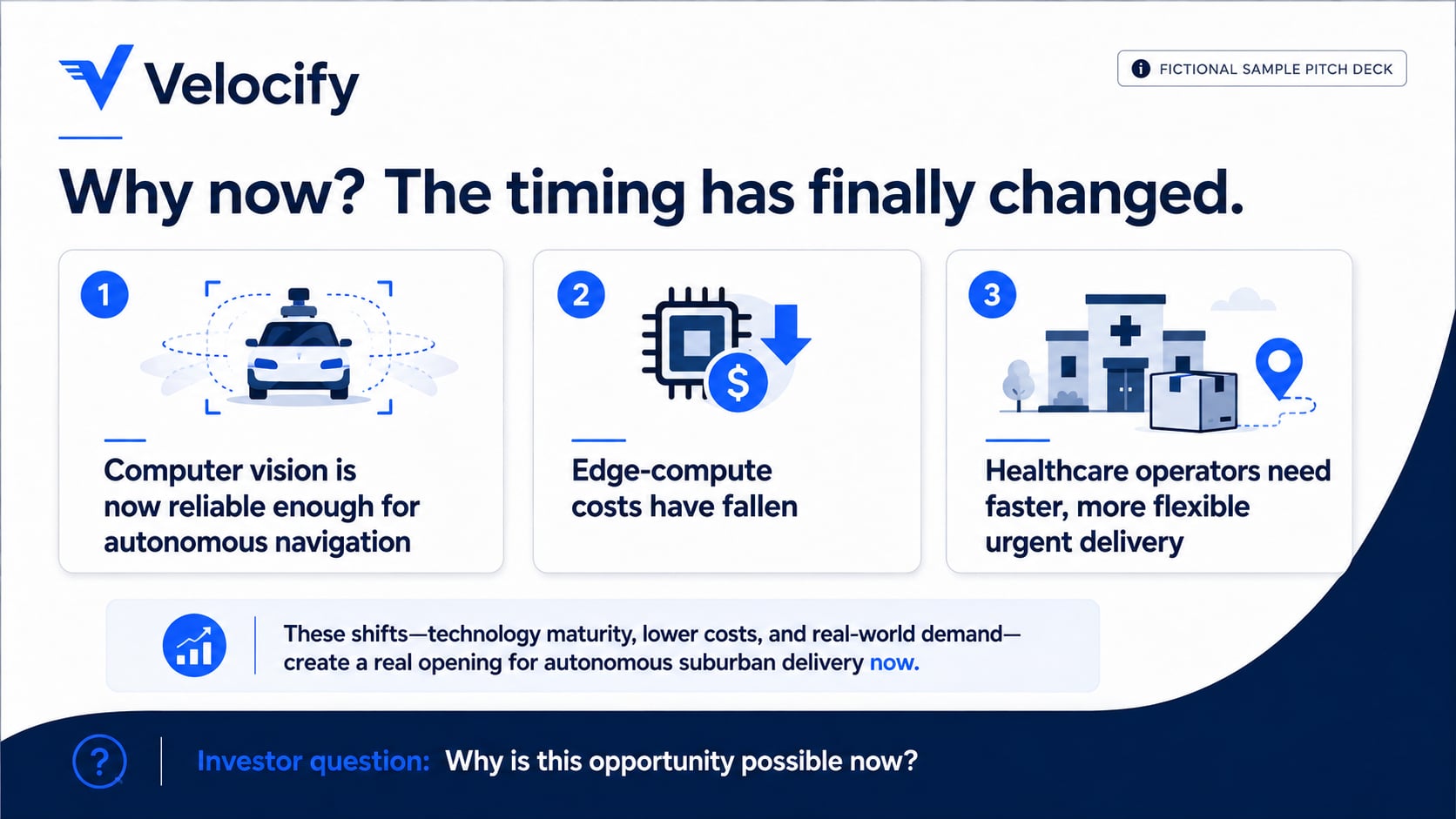
Improvements in onboard computer vision and lower edge-compute costs now allow autonomous drones to perform navigation tasks that previously required remote human operators.
The goal is to explain why the opportunity exists now, not simply why the industry is interesting.
✓ Stronger
✓Three specific, concrete shifts—not a vague industry trend
✓Each shift is stated as a fact, not an opinion
✓The callout ties the shifts directly back to why now
6. Market Opportunity
What the Investor Is Really Asking
“If this works, could it become a large company?”
At pre-seed, your market sizing does not need false precision. But investors still need to see venture-scale potential. Avoid relying only on a statement like "the global logistics market is worth $10 trillion." Instead, connect the market to actual customers.
Then explain how the company could expand beyond that initial segment. A good market slide combines a realistic entry market, a clear customer, and a believable expansion path.
7. Business Model
What the Investor Is Really Asking
“How could this eventually make money?”
At pre-seed, your business model may still evolve. That's okay. But the investor should understand the basic economics: who pays, what they pay for, approximate pricing, and how revenue may expand.
Customer: Regional pharmacy networks
Subscription: $2,500 per location / month
Delivery fee: $8 per urgent delivery
Expansion: More locations + premium service levels
Be clear about what is already validated and what is still a hypothesis.
8. Early Validation / Traction
What the Investor Is Really Asking
“What have you learned that makes this less risky than just an idea?”
At pre-seed, traction does not always mean revenue. It may include customer interviews, prototype usage, design partners, pilots, LOIs, waitlist conversion, early revenue, technical milestones, or regulatory progress.
A useful progression is:
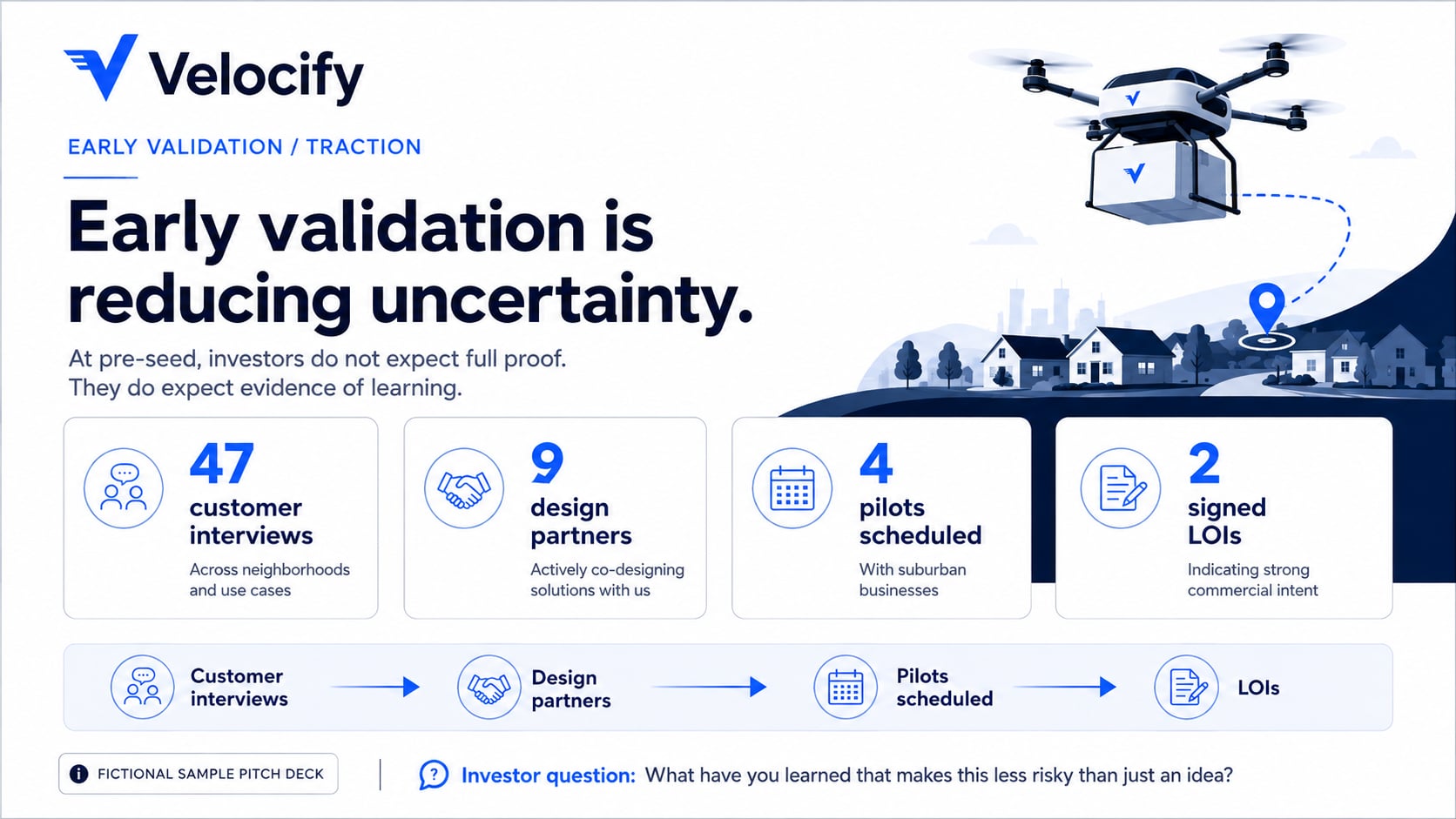
Customer Interviews → Prototype → Design Partners → Pilot → LOI / Paid Customer
✕ Weak
We spoke to potential customers.
✓ Stronger
47 customer interviews
9 design partners
4 pilots scheduled
2 signed LOIs
This is much more useful because it shows progression.
At pre-seed, investors do not expect full proof. They do expect evidence of learning.
✓ Stronger
✓Four specific numbers, not a vague claim of customer interest
✓The flow shows a progression, not just a snapshot
✓The framing—reducing uncertainty—matches what pre-seed investors actually expect
9. Go-to-Market Hypothesis
What the Investor Is Really Asking
“How do you think you will get the first customers?”
At pre-seed, your GTM does not need to be optimized. It does need to be specific.
✕ Weak
SEO
Social media
Partnerships
Direct sales
✓ Stronger
Initial customer: Regional pharmacy networks
Acquisition: Founder-led outbound
Early evidence: 220 targeted accounts → 31 meetings → 14 pilot discussions
Expansion: Pilot → annual contract → network rollout
The investor wants to see a mechanism, not a list of marketing channels.
Do not say "we have no competitors." Customers are already doing something—using another startup, using an incumbent, using Excel, relying on employees, outsourcing, or doing nothing.
At pre-seed, you do not need to prove an unbeatable moat. But you should demonstrate that you understand the real alternatives, customer decision criteria, and why your approach may be meaningfully better.
11. Team
What the Investor Is Really Asking
“Why should we bet on this team before the company is proven?”
At pre-seed, the Team slide can be one of the most important slides in the deck. Because there is less business evidence, investors often place more weight on founder quality. Focus on relevant industry experience, technical capability, founder-market fit, unique insight, customer access, previous execution, and why the founders chose this problem.
Avoid simply listing biographies.
✕ Weak
Jane Doe — MBA. Former Consultant.
✓ Stronger
Jane Doe — CEO. 10 years managing pharmacy logistics operations and direct relationships with 80+ regional healthcare operators.
The second version tells the investor why the background matters.
12. Fundraising Ask
What the Investor Is Really Asking
“What does this round allow you to prove?”
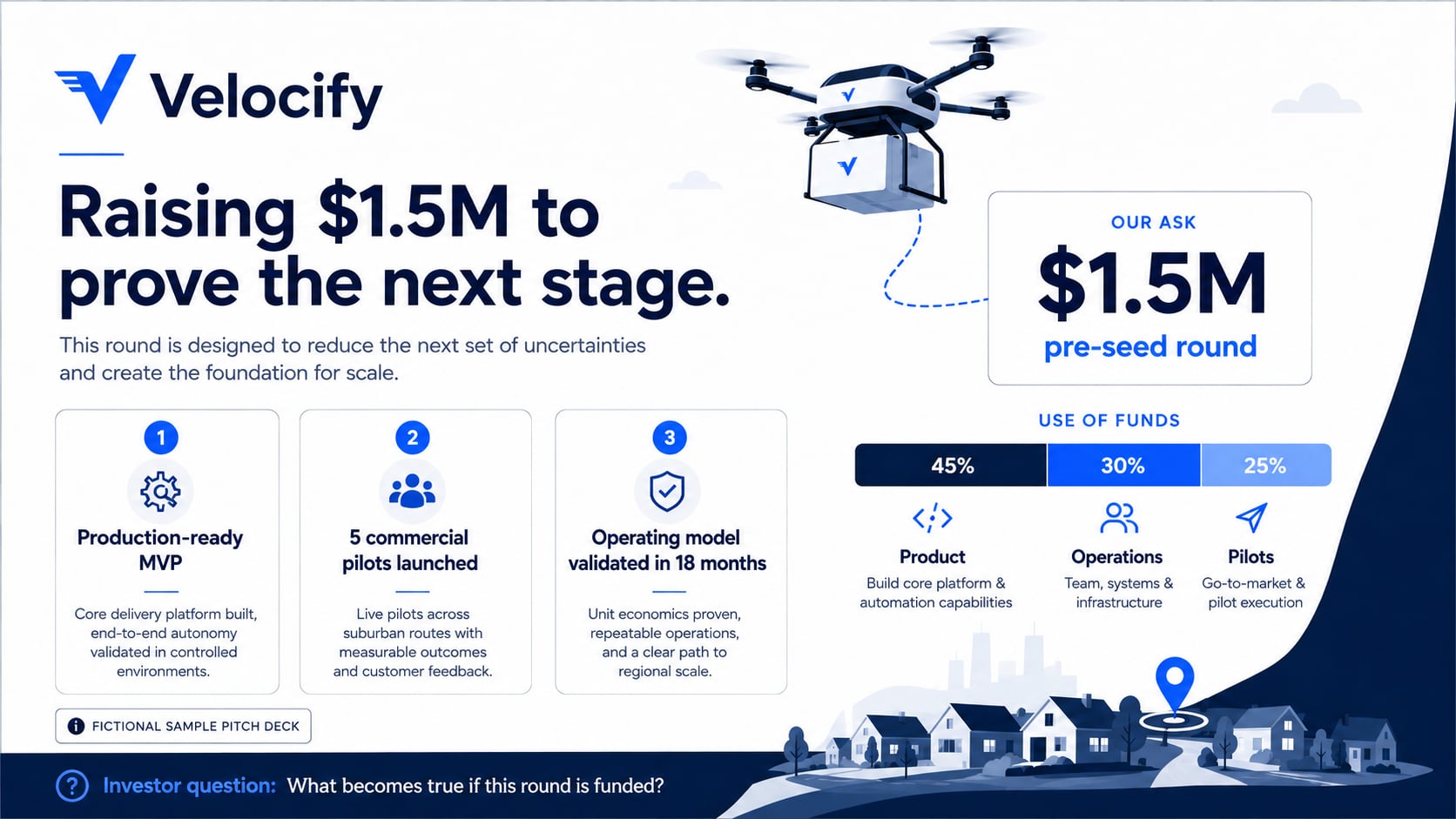
Your Ask should connect capital to milestones.
✕ Weak
Raising $1.5M.
✓ Stronger
Raising $1.5M to complete the production-ready MVP, launch five commercial pilots, and validate the operating model over the next 18 months.
At pre-seed, the purpose of the round is often to reduce the next set of uncertainties. The investor should know what becomes true if the round succeeds.
✓ Stronger
✓The ask is a specific amount, not a round number chosen arbitrarily
✓Three milestones the round is meant to unlock, not just a use-of-funds pie chart
✓Use of funds is broken down by category, so the investor can sanity-check it
What Can Be De-Emphasized at Pre-Seed?
Compared with later-stage decks, pre-seed companies usually need less emphasis on:
five-year financial projections,
mature CAC / LTV analysis,
detailed sales efficiency metrics,
large historical revenue charts,
extensive organizational structure.
That does not mean avoiding numbers. It means using the numbers that matter for the stage you are actually in. At pre-seed, strong evidence often comes from customer behavior, prototypes, pilot demand, founder insight, and learning velocity.
Common Pre-Seed Pitch Deck Mistakes
1. Trying to look like a later-stage company
Do not manufacture maturity that does not exist.
2. A generic problem
If the same statement could describe hundreds of startups, make it more specific.
3. Treating interest as traction
A customer saying "interesting" is different from signing an LOI, running a pilot, or paying.
4. Vague GTM
"Social media + partnerships" does not explain how the first customer buys.
5. Too much technology too early
The investor should understand the problem and customer before the technical deep dive.
6. Weak founder-market fit
Do not make investors guess why this team is qualified.
7. Asking for money without milestones
Explain what the capital is intended to prove.
Checklist
Can someone understand what the company does immediately?
Is the customer clearly defined?
Is the problem specific and meaningful?
Does the solution clearly solve that problem?
Can the investor see what exists today?
Is there a strong Why Now?
Does the market feel large enough?
Is the business model understandable?
Are we showing real validation?
Is the GTM hypothesis specific?
Have we acknowledged real competitors and alternatives?
Does the team slide explain founder-market fit?
Is the Ask tied to clear milestones?
Does the deck still make sense without our verbal explanation?
Pre-Seed Is About Reducing Uncertainty
A strong pre-seed deck does not prove that the company has already won. It shows that the founders are reducing the right risks.
The investor should leave the deck with clearer answers to questions like:
Is the problem real?
Do customers care?
Can the product work?
Why now?
Can this become large?
Is there early evidence?
Can this team execute?
At pre-seed, that is often enough to earn the next conversation.
Already Building a Pre-Seed Deck?
You may know which slides belong in the deck. The harder question is:
Does the story actually create belief?
A pre-seed deck does not need to look like a Series A deck. It needs to make a compelling early-stage case.
Does the story actually create belief?
VC Radar reviews your pitch across the key dimensions investors care about and highlights areas that may be unclear, unsupported, inconsistent, or missing.